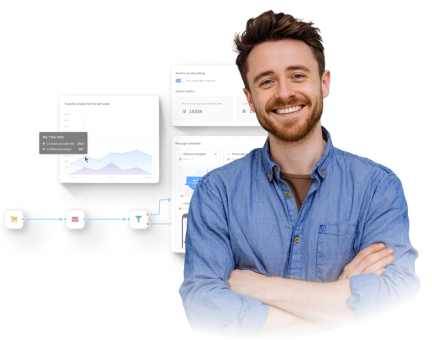
Unified Marketing Hub: Capabilities and Use Cases
How a unified marketing hub works
Such a system organizes data from multiple sources: websites, apps, email campaigns, messengers, advertising platforms, and other touchpoints. The foundation of this approach is usually a CDP (Customer Data Platform) — a system for managing customer data. It creates a unified customer profile that includes information about user behavior, purchases, and responses to communications. Within the same environment, automated scenarios are built, campaigns are configured, and communications are launched across all relevant channels. This turns the platform into a full operational center where marketing becomes structured, flexible, and personalized.
Customer profile in Altcraft Platform
What problems a unified marketing hub solves
- Fragmented data. When customer data is stored across CRM systems, advertising platforms, and third-party tools, marketers lose a single source of truth. As a result, segments are incomplete, and customers receive duplicate or irrelevant offers. A Unified Marketing Hub addresses this by consolidating all data sources in one place, eliminating duplicates and missed contacts.
- Disconnected channels. When different tools are used for email, push, SMS, and messengers, communication becomes inconsistent. A customer may receive multiple messages with the same offer at once or miss them entirely due to mismatched settings. Centralized management synchronizes all channels. The system builds logical scenarios: if an email is not opened, the message is sent through another channel where the user is more active, such as push or a messenger.
- Lack of transparent analytics. When marketing activities are spread across different tools, it is difficult to evaluate performance and calculate return on investment (ROI). A unified system collects data from all channels. A strong platform shows engagement and conversion at every step — who opened an email, who clicked a link, and so on. With this kind of end-to-end analytics, campaigns can be adjusted in time and unnecessary budget losses can be avoided.
- Manual work and errors. Without automation, marketers spend a lot of time preparing campaigns, filtering databases, and compiling reports. A centralized marketing hub automates routine tasks: campaigns are set up once and then run based on triggers or schedules.
- Personalization challenges. Without a unified customer profile, it is difficult to segment the audience in depth. A centralized platform allows combining different filters (customer journey, demographics, and more) and running targeted email campaigns and other communications for narrow segments.
How to choose a marketing platform
When selecting a unified marketing platform, make sure it covers all key tasks and supports the required capabilities. Main criteria:
- Unified CDP and customer database. The platform should collect data about all customers in one place. This means integration with CRM systems, web analytics, and other sources. A unified customer profile makes it possible to run marketing campaigns based on a complete view of purchase history and interactions.
- Omnichannel support. Check whether the platform supports all required channels (email, SMS, push notifications, messengers, etc.). The broader the channel set, the more flexible the marketing strategy. At the same time, communications should be connected: the system must be able to build end-to-end flows where each step depends on the customer’s response.
- Marketing automation. The platform should support not only one-time campaigns but also multi-step automated scenarios triggered by user actions. The system should respond to customer behavior — for example, switch the channel if an email is not opened. This reduces manual work and keeps campaigns running without constant intervention.
- Marketing personalization. Evaluate how quickly the platform allows you to set up segmentation and personalization. A marketer should be able to create segments in a few clicks (based on past purchases, activity, demographics, etc.) and define personalized conditions in campaigns or templates. This makes it possible to tailor each message to a specific audience without involving IT.
- A/B/n testing. The system should support split testing — comparing different versions of messages, subject lines, and offers (in email, push, etc.).
- Advanced analytics. Built-in reports and real-time dashboards are essential: email opens, clicks, conversions, ROI. The platform should group results by segments, channels, and scenarios so it’s clear what works and what doesn’t. Altcraft provides detailed end-to-end analytics for automated flows and multiple metrics.
- Integrations. Check for ready-made integrations and API availability. The easier the platform connects with CRM, CMS, and other services, the faster you can launch campaigns.
- Security and scalability. Review how data is stored. Many companies choose on-premise deployment (hosting on their own servers) for better data security.
Who a Unified Marketing Hub is suitable for
Altcraft case studies show that the platform works effectively across different industries:
- Banking sector. In projects with BNB Bank and Otkritie Broker, Altcraft was deployed within the companies’ infrastructure and unified all customer communications. At BNB Bank, trigger-based onboarding flows were launched for each product. The open rate reached about 60%, CTR about 12%, and transaction activity increased by 36%. Otkritie Broker consolidated data into a single database and integrated SMS gateways and SQL tables to use existing data in trigger campaigns. The first trigger campaign showed a 75% open rate and 27% CTR. The annual platform subscription paid off within three months.
- Insurance companies. For AlfaStrakhovanie Group, Altcraft implemented a complex integration with an internal CDI system and automated marketing scenarios. The task was to process large volumes of customer data without transferring it to the cloud and to configure flexible triggers. The platform enabled micro-personalized communications across email, push, and SMS with hundreds of scenarios. Over a year, open rate reached 42%, CTR 36%, repeat purchases increased by 49%, and online sales revenue grew by more than 30%.
- Media and digital projects. The online cinema PREMIER implemented Altcraft Platform to unify all marketing channels and automate subscriber interactions. After deploying the on-premise solution, all campaigns (email, push, SMS, messengers) were managed from a single system, which increased operational speed. Campaign preparation and launch time decreased from three hours to one. Over six months, retargeting email campaigns, supported by deep segmentation, increased the open rate by 1.5× and the click rate by 2×.
- Travel and entertainment. The gift certificate service Cuva (travel across Russia) used Altcraft Platform to set up omnichannel CRM marketing and automate welcome emails, upsells, and reactivation campaigns. The audience was segmented by activity level: inactive users, those who opened emails but didn’t click, and those who showed interest but didn’t purchase for six months. Separate scenarios were created for each segment — from content and surveys to personalized promo codes. Email and call center operations were synchronized: if a user opened an email but didn’t complete a purchase, the data was passed via API so an operator could assist. As a result, the share of sales from CRM campaigns increased from 8% to 15%.
Conclusion
Altcraft brings channels together and automates processes so marketing campaigns run consistently and predictably.